

Planning Poker: estimate, prioritise and make decisions together
17 October 2024Decisions, Planning, Prefix playing card
Planning Poker is a collaborative method that allows each member of a team to assess a task or option using a set of cards. Each person chooses a card without knowing what the others have selected, then all cards are revealed simultaneously.
Differences in estimates then become the starting point for discussion. Widely used in agile project management to estimate the effort required for a task, Planning Poker can also be useful in many other situations.
What can Planning Poker be used for?
Planning Poker can be used to:
- Estimate tasks by comparing their effort or complexity.
- Prioritise tasks or projects according to their importance, urgency or impact.
- Assess risks by estimating their likelihood or consequences.
- Compare different options using the same criterion.
- Reveal differences in perception within a team before making a decision.
The principle remains the same: each person makes an individual assessment before discovering how others have evaluated the situation.
How do you use Planning Poker?
Start by clearly defining what you want to assess and according to which criterion: effort, complexity, risk, priority or impact.
Each person then chooses a card and keeps it hidden. The cards are revealed simultaneously and any differences are discussed.
These differences are often the most interesting part of the exercise. They may reveal information that others were unaware of or simply a different perception of the situation. After the discussion, the team can make another estimate if needed.
Why use cards with these values?
Revealing all the cards simultaneously helps limit the influence of the first opinions expressed. Each person can make their own assessment before seeing the rest of the group’s estimates, making it easier to identify and discuss differences in perception.
The values generally follow a sequence inspired by Fibonacci: 1, 2, 3, 5, 8, 13… The more complex or uncertain a task becomes, the harder it is to estimate precisely. Increasing the gaps between values therefore encourages teams to think in orders of magnitude rather than seek artificial precision.
Planning poker cards
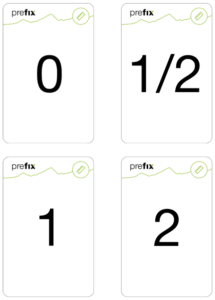
Planning Poker typically uses the values 0, 0.5, 1, 2, 3, 5, 8, 13, 20, 40 and 100, along with a “?” card to express uncertainty.
Download the Prefix cards
To make it easy to experiment with this practice with your team, Prefix provides its Planning Poker card deck for you to download and print.
Put Planning Poker into practice with your team
Would you like to experiment with Planning Poker using a real situation? Prefix can design and facilitate a workshop with your team, based on your projects, priorities or decisions. It is a practical way to discover the tool while working on your own challenges.